

Specialized U-Line Appliance Repair in San Francisco
Mon–Sat: 8:00 AM – 7:00 PM
Ice that melts as fast as it is made looks exactly like low production. Here is how to tell the difference and what to note for a technician.
Everything sounds right, since the compressor cycles, water moves and ice drops. Yet on Saturday morning the bin holds a thin layer and you are out of ice by the second round of drinks. Most people read that as a production problem. Sometimes it is a retention problem, which has different causes and a different repair path.
Make a simple test. Empty the bin, close it, and note the time. Check again after a few hours without opening it. If the ice has built up a steady layer, the machine produces and the problem is how you use it. If the layer is small and wet, with water in the bottom of the bin, ice is melting almost as fast as it arrives.
Production problems have their own article, evaporator codes on nugget machines and the cleaning-related causes in ice maker cleaning reminders cover the freezing side. This article is about the bin.
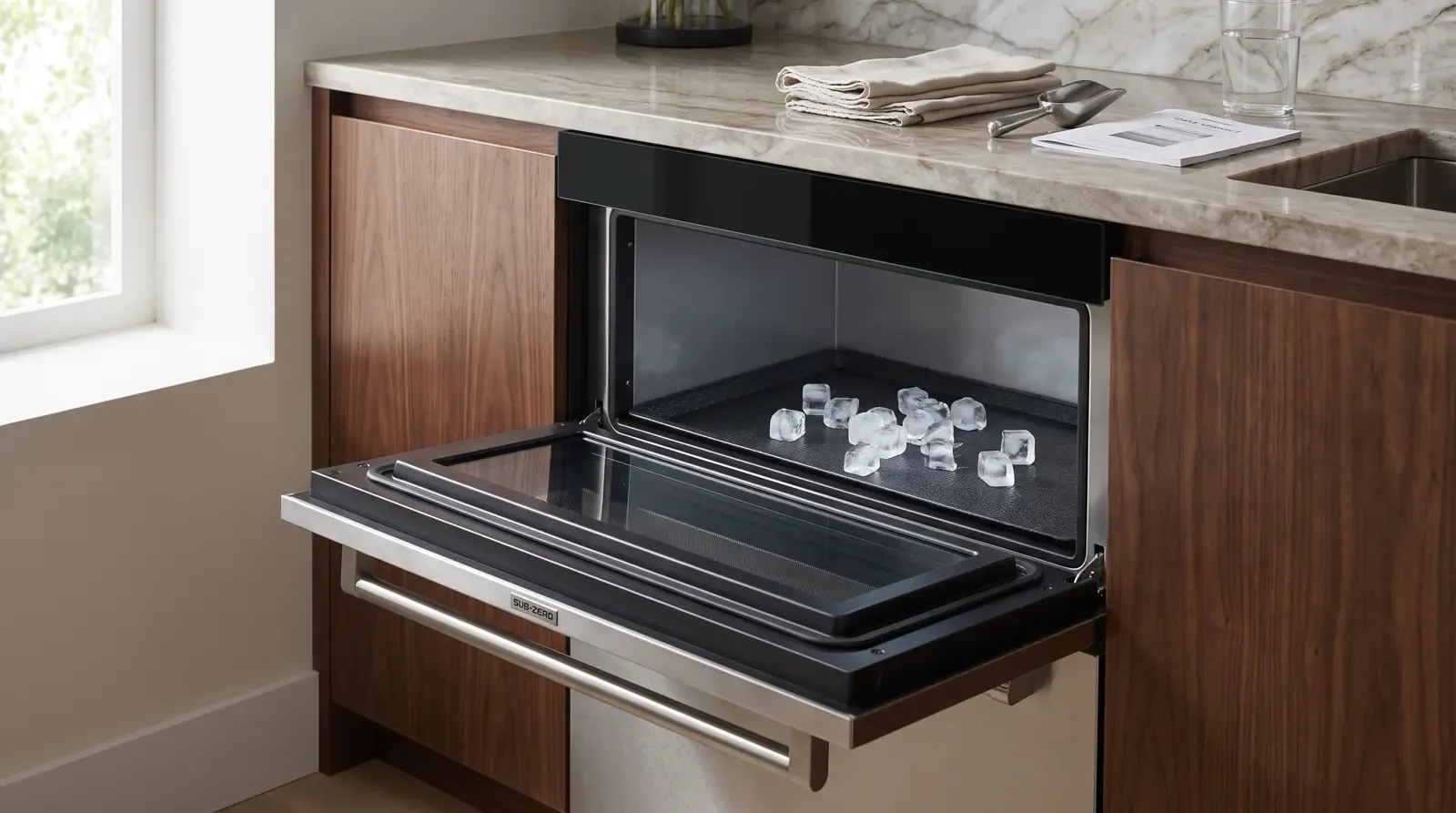
An ice storage bin is a small refrigerated compartment, and it depends on the door sealing. A scoop handle resting under the door, a few cubes lodged in the seal, or a door that does not latch lets warm air in, and the ice at the top melts into the layer beneath. The control may notice too: the code list includes Door Open 5M, which describes a door switch that has been open for more than five minutes, and the 10E display, which is described as typically related to a door seal issue. Some machines also stop making ice while the door is considered open.
Close the door slowly and watch whether it seats all the way. Run a finger around the gasket and remove any ice or debris. If the door sags or the gasket has a flat section, mention that to the technician.
Ice machines read bin conditions with a thermistor. The code list includes Bin T Open and Bin T Short for an open or shorted bin sensor circuit. A bin sensor that misreads can make the machine think the bin is full and stop early, or make it behave oddly when it should hold the bin cold. In that situation, ice quantity looks wrong even though water supply and freezing are fine.
This is not an owner repair. What is useful is observation: does the machine stop when the bin is only a third full? Does the bin feel warm at the front? Does a code appear after a long stretch of standing idle? These clues point toward the sensor circuit rather than the freezing system.
An ice maker next to a dishwasher, a range or a sunny window sees warm surroundings, and a bin in a warm kitchen loses ice faster. In summer in the East Bay and South Bay, a kitchen can sit well above the room temperature the machine handles comfortably. In a foggy coastal neighborhood, the opposite can matter: a cold, damp garage bar may form frost in the bin door seal overnight.
Ventilation is part of the same story. If the front opening is blocked by stored items or a mat, the machine rejects heat poorly and works longer for the same ice. Clear the space and see whether the bin improves over a day or two.
Machines rated for different capacities make ice at different rates, and a household that serves forty guests will outrun any compact unit. If you expect a crowd, run the machine early and let the bin build for a full day beforehand.
Crescent machines are known for thin crescents and incomplete harvest. Nugget machines for soft ice, missing nuggets and grinding sounds. Clear ice machines for cloudy ice, scale-related faults and low output. A low bin on a crescent machine may mean cubes are not dropping at all, while on a clear ice machine it may mean the cycle is slow because of mineral scale. A refrigerator and ice-maker combination adds a shared cabinet that has its own temperature to hold. Naming the type you own saves a round of questions.
Where the ice is stopped also matters. A no-ice complaint can halt at water fill, freezing, harvest, the auger or drainage, depending on the type, and the bin is only the last stop. If you can say which stage you think was reached, for instance that water arrived but nothing froze, that is a real clue.
Choose one quiet day and keep a simple log. Empty the bin in the morning and write the time. At each check, record how full the bin is, whether the ice is dry or wet, whether water has pooled at the bottom and whether the door is still seated. Note the kitchen temperature if you can feel the difference, and write down any display message exactly as shown before pressing anything. Two or three entries are enough to show whether ice is arriving slowly or leaving quickly.
Record the model number, serial number and production suffix at the same time, plus any recent changes such as new cabinetry, plumbing work or a power interruption. Those details help a technician decide where to begin without guessing.
Switch the unit off and request a diagnosis if you see smoke, a burning-electrical smell, arcing, a breaker that trips repeatedly, severe overheating or water reaching electrical parts. A bin that is merely slow to fill is not an emergency, but water pooling around the cabinet is worth acting on quickly. Stop repeating resets if the condition comes back, and do not open the panels or sealed refrigeration circuits yourself.
If the symptom is constant, repeatable or has begun to show a code, that is the point at which a diagnosis is more useful than another weekend of watching. The full list of codes is on the U-Line error codes page.
Tell the technician how the bin behaves during the first few hours after emptying, whether you see water at the bottom, whether the door closes fully, whether any code appeared, and the model number. For a crescent model, such as the HCR115, mention that as well since it shapes the diagnosis. You are told what was found, handed a written estimate and asked before any repair begins. Our U-Line ice makers page gives an overview of the types.
Empty the bin, close it and leave it for a few hours. A steady layer means the machine is making ice; a thin wet layer means it is melting.
Yes. A door that stays open for several minutes can trigger a door alert and some machines pause ice making.
The machine may stop with the bin partly full or behave oddly. Sensor circuits are inside, so it needs a diagnosis.
Yes. A warm kitchen melts bin ice faster and makes the machine work longer.
Share a few details and we’ll confirm an appointment. Prefer to talk? Call us and we’ll help right away.