Freezer Repair: Residential Freezers, Combos and Blast Chillers
Frozen food gives you little time. See how U-Line freezers, refrigerator/freezer combinations and commercial blast chillers are diagnosed, and what to do…

Specialized U-Line Appliance Repair in San Francisco
Mon–Sat: 8:00 AM – 7:00 PM
Before you can say what is wrong with a U-Line freezer, you need to know which kind it is. Here is how to tell the combination cabinet, the zoned residential freezer and the commercial blast chiller apart, and where each keeps its label.
People describe very different equipment as a U-Line freezer, and a repair conversation goes badly if the machine is misidentified at the start. We sort the cabinets into three groups, each with its own controls and its own vocabulary for trouble.
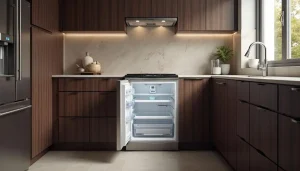
The HRF124 is a 24-inch 1 Class refrigerator and freezer in a single built-in cabinet, an indoor model. It has two compartments that are cooled and sensed separately, which means a warm freezer section can sit next to a perfectly cold refrigerator section and the reverse. This is the unit most households mean when they say a U-Line freezer.
Other residential freezer cabinets carry a left and a right zone. Their control keeps a history for each side and reports it separately, so a message can point at one zone only. Those messages include temperature excursions logged over six and twelve hours, evaporator sensor readings and a door switch left open beyond five minutes.
The UCBF platform is commercial equipment for pulling heat out of freshly cooked food. It runs cycles, uses food probes and reports alarms in words rather than short codes. It turns up in restaurant kitchens, wine bars, catering prep rooms and the occasional serious home kitchen.
| Equipment | Typical home | What the control reports |
|---|---|---|
| Combination cabinet | Kitchen island, butler’s pantry, home bar | Temperature and door conditions for each compartment |
| Zoned residential freezer | Kitchen, garage or utility room | Left and right sensor, temperature history and door messages |
| UCBF blast chiller | Commercial or catering kitchen | Cycle, probe, door, condenser and defrost alarms in plain words |
The way these are traced to a cause is covered on U-Line freezer repair, including what to do first when the food inside is at risk.
A freezer works against the temperature of the room around it, so the same cabinet behaves differently in a conditioned kitchen and in a garage. Around the Bay, a garage can be cool and damp on a foggy morning and uncomfortably warm by afternoon in an inland suburb. A residential cabinet is designed for a certain range, and one parked in a hot corner behind stored boxes may never get the air it needs. Check the installation instructions for the temperature range your model is rated for.
On a combination cabinet or a residential freezer, open the door and look at the inner side wall or the frame around the opening. A blast chiller usually carries its rating plate on the inside of the door frame or on the back of the cabinet, in a spot you can see without moving the machine. Photograph it and keep the picture with the date. If you have more than one cabinet in the same room, label the photos, because two units of similar width are easy to mix up.
Freezer controls report zone temperature history, door switch timing and communication between the display and the main board. Blast chillers add alarms for the air probe, the condenser, the evaporator, each food probe and an overrun defrost. The same short text can mean different things on a different platform, so always give the model with the message. Browse the U-Line error codes archive to read the wording for each platform.
Pack a freezer loosely enough that air can move, and keep soft packages away from the vents. Wipe the gasket when it feels tacky. Let a freshly loaded batch of warm food cool before it goes in, or use the chilling cycle if the equipment has one.
For a cabinet that is mostly a refrigerator, see U-Line refrigerators. If an ice maker shares your space, read about U-Line ice makers. To request a visit, go to contact.
Both. It is a 24-inch 1 Class cabinet with a refrigerator compartment and a freezer compartment, each with its own temperature behavior.
UCBF is the platform name of the U-Line commercial blast chiller, which pulls the temperature of hot food down in a controlled cycle and uses food probes.
Certain residential freezers have two zones, and the control reports each one separately so you can see which side is affected.
No. Metal tools can puncture a line. Note where the frost sits and how fast it returns, and describe that when you call.
Frozen food gives you little time. See how U-Line freezers, refrigerator/freezer combinations and commercial blast chillers are diagnosed, and what to do…
What sets a beverage center apart from a refrigerator, how single and dual-zone models differ, and the symptoms that bring owners to…
Three kinds of ice, 14, 15 and 18 inch cabinets, drain pump and gravity versions, and combo units: a map of the…
Which U-Line cabinets are built or listed for outdoors, how the Bay Area climate affects them and what to look for on…
How U-Line drawer refrigerators differ from standing cabinets, which versions exist and what typically goes wrong with seals, slides and open-drawer alerts.
Widths from 15 to 36 inches, ADA and outdoor versions and refrigerator/freezer and ice combinations: how the U-Line refrigerator lineup fits together…
Four collections, three widths of single-zone cabinet, dual-zone pairs and one 36-inch model: how the U-Line wine refrigerator range is laid out…
Share a few details and we’ll confirm an appointment. Prefer to talk? Call us and we’ll help right away.