Beverage Centers: Single-Zone, Dual-Zone and 36-Inch Models
What sets a beverage center apart from a refrigerator, how single and dual-zone models differ, and the symptoms that bring owners to…

Specialized U-Line Appliance Repair in San Francisco
Mon–Sat: 8:00 AM – 7:00 PM
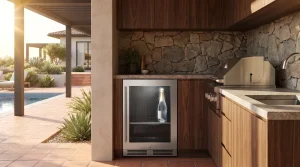
An outdoor refrigerator lives with sun, fog, wind and a cabinet that traps its own heat. Before blaming the compressor, it helps to know which problems are the climate and which are the appliance.
U-Line lists an Outdoor collection with refrigerators, drawers, beverage products and ice machines, and some Seamless and Home models are also rated for indoor and outdoor use. Those are not interchangeable with an indoor-only cabinet that someone has moved to a patio. If you are unsure which you have, the data label and the model number settle it, and a model that is not rated for outdoors should not be run there.
The units we are called to are usually built into masonry or stainless islands, set into a cabinet beside a barbecue, or tucked under a covered deck. All of those places have one thing in common: they hold heat around the cabinet and let weather reach the door.
San Francisco and the coast live with cool, damp fog, and salt-laden air creeps into the outer neighborhoods. Moisture sits on the gasket, the door face and the hinge parts for much of the year. Across the bay and down the peninsula, afternoons in East Bay and South Bay yards can run far hotter, with direct sun on a stainless door and a patio cabinet that never cools off overnight. A refrigerator that works fine in a shaded June can fall behind during a late-season heat spell without anything having broken.
Built-in outdoor cabinets rely on air passing in and out of the grille at the base. Island cabinetry frequently gets finished with a solid panel behind or below the unit, or the opening is sized to the fridge without leaving the clearance the installation calls for. We look at the opening, the grille, the space behind and what has been stacked around it, because a blocked path produces high temperatures that look like a failing compressor. If you can see debris, pollen or spiderwebs on the grille, a gentle brushing from the outside is fine; do not take the grille off.
Gaskets live on borrowed time outdoors. Sunlight dries the rubber, grease from a nearby grill collects on it, and a bit of grit on the sealing edge keeps it from sitting flat. Wipe it with a soft damp cloth and check that the door closes evenly. If the door has dropped on its hinge, the gasket will close at the top and gap at the bottom, which is a mechanical fix and not a cooling one. Salt air can also affect screws and trim over time, so we make a note of finish condition on coastal properties.
Never take the unit out of its opening, remove panels to inspect parts, or hose the front down. Water pressure is not what these cabinets are designed for.
We confirm that the model is rated for outdoor use, then record how it is installed: the opening, clearances, shade, grille and the circuit it is plugged into. Door sealing, airflow and fan operation are checked, followed by sensing and the control, and only afterwards the cooling circuit. Our U-Line refrigerator repair page describes the shared groundwork. The written estimate comes first; the work starts only when you approve it.
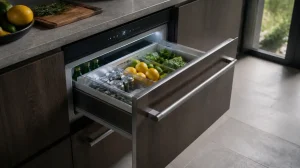
Outdoor drawers and beverage units follow the same logic; see U-Line refrigerated drawer repair and U-Line beverage center repair. If the unit is an outdoor ice machine, U-Line ice maker repair covers the water-side checks.
Switch the unit off at the outlet if there is a burning smell, if water reaches the plug or an outdoor receptacle, or if the breaker trips again after a reset. Heat alone is not a reason to run a failing unit: if the cabinet is hot to the hand and the compressor hums without cooling, turn it off and move food.
For a product overview see U-Line outdoor refrigerators, or book through contact.
Not always. Sun and a hot island cabinet raise the load, and restricted ventilation makes it worse. If it recovers in the evening, the first things to examine are clearance and the grille.
No. Only models listed for outdoor use are designed for it. The label and model number confirm which type you have.
Moisture and salt can affect gaskets, hinges, trim and fasteners over time, particularly near the coast. They usually cause seal and finish problems before they cause cooling problems.
Reset the GFCI once if it is safe, and note whether it trips again. If it keeps tripping, unplug the unit and have the circuit looked at before using it again.
Avoid it. Wipe with a damp cloth and keep water away from grilles, hinges and the area around the control.
What sets a beverage center apart from a refrigerator, how single and dual-zone models differ, and the symptoms that bring owners to…
Which U-Line cabinets are built or listed for outdoors, how the Bay Area climate affects them and what to look for on…
How U-Line drawer refrigerators differ from standing cabinets, which versions exist and what typically goes wrong with seals, slides and open-drawer alerts.
Widths from 15 to 36 inches, ADA and outdoor versions and refrigerator/freezer and ice combinations: how the U-Line refrigerator lineup fits together…
Beverage centers get opened constantly and loaded with warm cans. Here is what goes wrong on single and dual-zone U-Line models and…
Frozen food gives you little time. See how U-Line freezers, refrigerator/freezer combinations and commercial blast chillers are diagnosed, and what to do…
No ice, thin cubes, standing water or an Er code: how U-Line crescent, clear and nugget machines fail at different stages and…
Drawers add alignment and gasket contact to the usual cooling checks. See what makes a drawer warm, frosty or stuck open, and…
A warm cabinet, a fan that never stops or frost on the back wall: how a U-Line undercounter refrigerator is diagnosed, and…
Wine needs steady temperature more than cold. See what drift, a constant fan or a fogged door means on single and dual-zone…
Share a few details and we’ll confirm an appointment. Prefer to talk? Call us and we’ll help right away.