Beverage Centers: Single-Zone, Dual-Zone and 36-Inch Models
What sets a beverage center apart from a refrigerator, how single and dual-zone models differ, and the symptoms that bring owners to…

Specialized U-Line Appliance Repair in San Francisco
Mon–Sat: 8:00 AM – 7:00 PM
When a built-in U-Line refrigerator drifts warm, runs nonstop or starts icing up, the cause is usually findable without guessing. Here is how we narrow it down, what you can check from the outside, and when to stop using the unit.
An undercounter U-Line leaves very little margin. The compressor, condenser, evaporator and control all sit inside a box that slides under your counter, and the heat it removes from the food has to go somewhere. That is why small faults show up fast: a gasket that no longer closes tightly, a grille half hidden behind a tray, a temperature sensor reading a few degrees off.
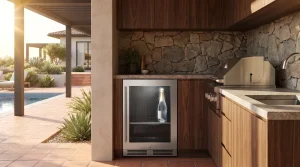
The cabinets we see most are 15, 18 and 24 inches wide, with 21-inch ADA-height units and 36-inch 3000 Series cabinets also. Some are plain refrigerators, some are refrigerator/freezer combinations such as the HRF124, and some pair a refrigerator with an ice maker, like the HRI124. Each of those behaves differently when something goes wrong, so the first job is always to identify exactly what is installed.
| What you notice | What you can look at from outside | What a diagnosis separates |
|---|---|---|
| Cabinet warmer than the set point | Door shut fully, nothing wedged against the gasket, grille clear | Airflow, sensing, fan, then the cooling circuit itself |
| Cabinet colder than it should be, items freezing | Whether food is pressed against the back wall | A sensor reporting too warm, or a control that keeps cooling |
| Fan or compressor running for hours | Warm loading, hot kitchen, blocked grille | Condenser airflow versus a genuine capacity loss |
| Frost or ice on the interior wall | Gasket gaps, a door left ajar overnight | Defrost behavior and moisture entering at the door |
| Display shows a code | The exact characters, written down before any reset | Which control platform the code belongs to |
None of these rows points at a failed part by itself. A refrigerator that is warm only after a party tray went in is a different story from one that sat at the wrong temperature all weekend with the door closed.
Several residential refrigerator codes are about timing, not breakdowns. E10 means a top drawer stayed open longer than 20 minutes, and E3 is raised by the main door or a bottom drawer held open that long. A door switch left open for five minutes raises its own alert, door open 5M.
Others describe what the cabinet has been doing. Temp Hi 6H+ and Temp Hi 12H+ record a zone running more than 10 degrees Fahrenheit above its set point for six or twelve hours. E4 notes that the compressor ran at full duty between two defrost cycles. The same text on a different control generation can mean something else, which is why the model number goes with the code. The U-Line error codes archive lists the rest.
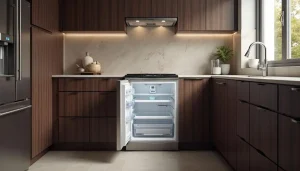
Most of these refrigerators are built in. Front-venting means the grille at the bottom of the cabinet is the intake and exhaust for condenser air, so a toe-kick panel added in a remodel, or a shelf of cleaning supplies pushed up against the grille, can starve it. In older San Francisco flats the cabinet often sits in a narrow galley with an oven or dishwasher beside it, which warms the space around the unit on cooking days.
None of that proves a component has failed. It tells us where to look first, and it keeps us from replacing a sensor when the real issue was a hot, cramped opening.
Do not open the cabinet back, pull it from its opening, or work on anything connected to the sealed system.
Unplug the unit and call for service if you smell burning, see smoke, find water pooled near the outlet, or the breaker trips repeatedly. A refrigerator that is simply warm can wait a day or two, but move perishables to another refrigerator so nothing is lost while it does.
The data label inside the cabinet identifies the control platform, whether a drain pump is fitted and whether the unit is rated for outdoors. Collections such as 1 Class, 5 Class, Seamless and Home use different parts, and a cabinet that looks identical from the front may not be. If the label is hard to read, a phone photo is enough, and the model directory can help you match it.
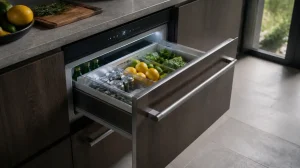
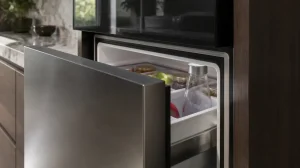
Drawer-style cabinets are covered under U-Line refrigerated drawer repair, and U-Line refrigerators gives an overview of the lineup. To book, use the contact page.
Not necessarily. A working display only proves the control has power. A loose door seal, a blocked front grille or a sensor reading incorrectly can all leave the cabinet warm, so those are ruled out before anyone looks at the compressor.
A small cabinet in a hot kitchen or an enclosed cabinet opening has to work harder to shed heat. Long run times are worth watching, but they become a repair question only if the temperature also drifts or the unit is louder than before.
It may hide the problem for a while, but frost usually means moisture is getting in or a defrost function is not completing. Note where the frost forms and whether the door closes fully, then have it diagnosed.
Yes. Combination units have two systems that can fail together or separately, so the cabinet temperature and the ice production are recorded separately before testing begins.
The model number from the label inside the cabinet, any code shown on the display, and a short description of when the problem started and whether it comes and goes.
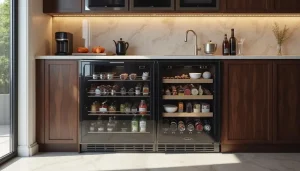
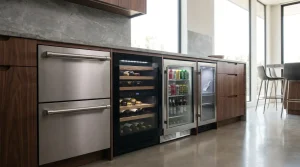
What sets a beverage center apart from a refrigerator, how single and dual-zone models differ, and the symptoms that bring owners to…
Which U-Line cabinets are built or listed for outdoors, how the Bay Area climate affects them and what to look for on…
How U-Line drawer refrigerators differ from standing cabinets, which versions exist and what typically goes wrong with seals, slides and open-drawer alerts.
Widths from 15 to 36 inches, ADA and outdoor versions and refrigerator/freezer and ice combinations: how the U-Line refrigerator lineup fits together…
Beverage centers get opened constantly and loaded with warm cans. Here is what goes wrong on single and dual-zone U-Line models and…
Frozen food gives you little time. See how U-Line freezers, refrigerator/freezer combinations and commercial blast chillers are diagnosed, and what to do…
No ice, thin cubes, standing water or an Er code: how U-Line crescent, clear and nugget machines fail at different stages and…
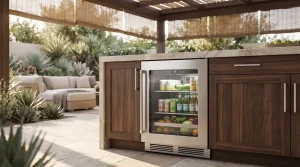
Outdoor U-Line units face sun, fog and cramped island cabinets. Learn what weather does to them, what is not a fault, and…
Drawers add alignment and gasket contact to the usual cooling checks. See what makes a drawer warm, frosty or stuck open, and…
Wine needs steady temperature more than cold. See what drift, a constant fan or a fogged door means on single and dual-zone…
Share a few details and we’ll confirm an appointment. Prefer to talk? Call us and we’ll help right away.