Ice Makers: Crescent, Clear and Nugget Machines Explained
Three kinds of ice, 14, 15 and 18 inch cabinets, drain pump and gravity versions, and combo units: a map of the…

Specialized U-Line Appliance Repair in San Francisco
Mon–Sat: 8:00 AM – 7:00 PM
Ice machines fail in stages: water in, freezing, harvest, drain. Which stage stops tells us more than any single symptom. Below: crescent, clear and nugget models, and the checks you can do from outside.
An ice machine is a short cycle repeated all day: it takes water in, freezes it, releases the ice and drains or recirculates what is left. A machine that never fills is a different problem from one that fills but will not freeze, or freezes and will not let go. Watching which step stalls, and noting it, is the single most useful thing an owner can do before a visit.
U-Line makes three kinds of ice at residential scale. They share a bin and a water line, but the way each freezes and releases ice is different, which is why we deal with them separately below. The machines are 15 inches wide in most models, with a 14-inch crescent maker in the ADA and Marine lines and an 18-inch clear ice model in the 3000 Series.
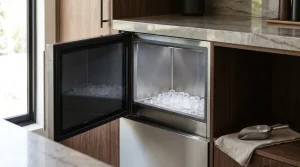
Crescent makers produce the familiar half-moon cube and depend on water supply, freeze timing, sensing and harvest. Complaints are usually of four kinds: small or incomplete cubes, an empty bin after normal run time, a leak, or unusual frost. A thin or ragged crescent often means a partial freeze or a water supply that is restricted, while a bin that stays empty can mean the cycle never reaches harvest.
Crescent machines show up in the Outdoor, ADA, Marine and 1 Class collections; the HCR115 is one example, and refrigerator/ice-maker combinations such as the HRI124 add a cooling system to the same enclosure.
Clear ice machines recirculate water while freezing to build dense, transparent ice, which makes them more sensitive to what is in the water. Cloudy ice, low output and scale-related faults often come back to water quality, recirculation or a freeze cycle that does not finish. San Francisco’s supply is soft, but in parts of the East Bay and South Bay hard water leaves mineral deposits faster, and a machine on a well-water line or an unsoftened tap will show it sooner. That is why the machines keep a cleaning reminder; the CL and Time to Clean messages should be taken seriously, not dismissed.
Whether a clear ice machine drains by gravity or by pump changes the diagnosis. The HCL115 and HCP115 pair, and the OCL115 and OCP115 pair, differ by exactly that, so the full label matters. Standing water, a pump that keeps running and a drain alert follow different paths on each. See HCL115 and HCP115 for the two layouts, and look up Drain Blocked in the U-Line error codes archive.
Nugget machines, such as the RNP115 and the outdoor-rated ONP115, form soft chewable ice on a cold evaporator and push it out with an auger. Because the process is continuous, the symptoms differ: slower output, soft slush, grinding or a machine that stops after a water alert.
These models report specific codes. Er15 is a water supply message: the sensor found no water level for two minutes, and the controller restarts by itself once five minutes have passed. Er16 is a drain problem: the lower-limit sensor is not detected in time while draining. Er01 and Er03 describe an evaporator that is still at or above 32 degrees Fahrenheit after 30 and 10 minutes of ice-making, and Er25 an evaporator that has dropped to a freezing condition. Each describes what the controller saw, not which part failed, and all of them are listed in the U-Line error codes archive.
Do not take apart the pump, the auger or anything that carries water inside the cabinet.
Pay attention to the moment water shows up, whether during filling, circulation, harvest or draining. Each points to a different place, and a photo of the puddle and a note of the timing helps enormously. A pump that hums, an auger that grinds or a harvest that bangs should be described in words as well as possible.
We confirm which type of ice machine it is, check water availability and fill, then test the stage where the cycle stops, including drain or pump behavior, before looking at sensors, controls and the cooling circuit. Our findings go into a written quote, and no part is touched before you sign off. Afterward, we run a cycle and confirm that the original symptom is gone. For an overview, see U-Line ice makers; to book, go to contact.
If the leak is near wiring, the machine has a hot smell, or water has reached an outlet, unplug it and close the supply valve.
Look at the ice, and at the model label. Half-moon cubes are crescent, dense square cubes with little cloud are clear, and soft pebble-like pieces are nugget.
Cloudy ice often comes from water quality or a cycle that needs cleaning. If cleaning does not change it, the recirculation or freeze stage needs testing.
On the RNP115 and URNP115 nugget platform the sensor found no water for two minutes, and the controller then restarts itself. It points to a supply condition, not to one failed part.
Repeated pump runs can come from a restricted drain, a drain line that rises or sags, or a sensing problem. Whether your model has a pump at all depends on its full production label.
Follow the cleaning instructions in your owner manual for your specific model. Do not dismantle the pump, auger or water path to clean them.
Three kinds of ice, 14, 15 and 18 inch cabinets, drain pump and gravity versions, and combo units: a map of the…
Beverage centers get opened constantly and loaded with warm cans. Here is what goes wrong on single and dual-zone U-Line models and…
Frozen food gives you little time. See how U-Line freezers, refrigerator/freezer combinations and commercial blast chillers are diagnosed, and what to do…
Outdoor U-Line units face sun, fog and cramped island cabinets. Learn what weather does to them, what is not a fault, and…
Drawers add alignment and gasket contact to the usual cooling checks. See what makes a drawer warm, frosty or stuck open, and…
A warm cabinet, a fan that never stops or frost on the back wall: how a U-Line undercounter refrigerator is diagnosed, and…
Wine needs steady temperature more than cold. See what drift, a constant fan or a fogged door means on single and dual-zone…
Share a few details and we’ll confirm an appointment. Prefer to talk? Call us and we’ll help right away.